You're paying for a graveyard. Every month, the same parade of subscriptions hits your card, ChatGPT, Midjourney, Runway, ElevenLabs, Notion AI, Suno, Descript, and somehow you're still not getting the output you need. The problem isn't the tools. It's the architecture. In 2026, the best AI platform isn't the one with the flashiest single feature. It's the one that makes all of it work together.
That platform is Kunya.
The Real Cost of Your AI Stack
Let's do the math most people avoid:
ChatGPT Plus — $20/month
Midjourney — $10/month
Runway Gen-3 — $15/month
ElevenLabs — $22/month
Notion AI — $10/month
Suno — $8/month
Descript — $24/month
Adobe Firefly — $10/month
Perplexity Pro — $20/month
Jasper or Copy.ai — $40–$150/month
That's $179–$289/month at the conservative end, and just for a team of one! Add one or two more tools and you're at $300+ before you've done a single hour of real work. And none of these tools talk to each other. Your brand voice lives in one tab. Your video assets live in another. Your meeting notes are somewhere else entirely.
Kunya replaces all of it. Starting at $19/month.
Workspaces: The Free Foundation That Actually Works
Most AI platforms bolt a chatbot onto a document editor and call it a workspace. Kunya built the workspace from the ground up, and the base version is always free.
Kunya Workspaces gives fully customizable documents, that you can reference in your AI chat, nine database views (table, board, calendar, gallery, timeline, and more), real-time collaboration, semantic search across all your content, Excel tier spreadsheets, formulas, pivot tables, and whiteboards for planning. This isn't Notion, or Miro or excel where the AI can autocomplete your sentences for you. This is a workspace where the AI is native to every action, and it can actually take control of your workspace for you, very much like having an intern or full time staff member there to manage your docs and sheets, and even perform work on them.
The base workspace is free. AI Agents, the autonomous, multi-step task runners that can act across your workspace — are the powerful add-on layer for teams that want to go further. Start free. Scale when you're ready.
Video Production Studio: Every Major Model, One Place
Here's what that looks like in practice:
Kling 3 is the industry benchmark for realism and motion coherence. Body mechanics, camera movement, physics - Kling 3 handles complex scenes without the warping and morphing that plagued previous generations. If you need a product shot, a lifestyle clip, or anything that needs to look like it was actually filmed, this is your model.
Seedance 2 is where you go when you want something that doesn't look like AI video. It excels at stylized, art-directed output - cinematic grading, intentional composition, a real directorial eye. Where most video models produce content that screams "generated," Seedance 2 produces content that looks like it was shot.
Google Veo sets the quality ceiling. It's Google's flagship for a reason - 4K output, long-duration generation, and a deep understanding of scene structure that makes it ideal for narrative work, ads, and anything that needs to hold together over longer sequences.
Sora Pro is OpenAI's entry, and its superpower is understanding what you actually meant. Complex prompts, layered instructions, specific aesthetic directions - Sora Pro interprets intent better than anything else in the space. It's the model to reach for when your brief is nuanced and you need the output to match the vision in your head.
The point isn't that one of these is "the best." The right video model depends on the job - realism, artistry, duration, or interpretation - and in 2026, any production workflow locked into a single video model is leaving results on the table.
Kunya lets you switch between all of them in the same studio, alongside your scripts, your voiceovers, and your brand context. No re-uploading assets. No switching tabs. No separate subscriptions. Your entire video workflow - from idea to export - lives in one place.
Image Generation Studio: Replace Midjourney and Photoshop
Midjourney charges $10/month for one model, a Discord-based interface, and a queue. Kunya gives you every major image model from every major lab - in a professional studio - included in your subscription.
Here's what that looks like in practice:
FLUX 2 is the production workhorse. Complex scenes, dense compositions, multi-reference edits - FLUX executes instructions with a precision that makes it the go-to for serious creative work.
GPT Image 2 is the closest thing to a design assistant that actually understands context. It handles native image editing, accepts reference images, and excels at photorealistic product shots and packaging mockups that look like they came out of a real studio.
Riverflow V2 is Kunya's standout for text rendering and 4K output - perfect text-in-image, sharp detail, and fast enough for production pipelines that can't afford to wait.
Nano Banana Pro is Google's 4K-capable model built for high-volume asset production - thinking-enabled, reference-image-aware, and consistently reliable at scale.
Seedream 5.0 dominates stylized generation - illustration, anime, anything with a distinct artistic register - where photorealistic models flatten the style.
Z-Image Turbo is the smart pick when you need strong quality without burning through budget. Fast, capable, and punches well above its cost - ideal for iteration and high-volume runs.
And yes - Midjourney V7 is in Kunya too. Full parameter support, the same stunning aesthetics, directly in the studio. You're not giving anything up.
The point isn't that one of these is "the best." The right model depends on the job - and any workflow that locks you into just one is already behind. Kunya lets you switch between all of them in the same studio, alongside your scripts, brand documents, and voiceovers. No re-uploading. No tab-switching. No separate subscriptions.
Audio Studio: Voiceovers, Music, and Real Phone Calls
Audio Studio: Voiceovers and Music, One Place
Suno is the model that made AI music a serious conversation. Full songs, real structure, actual lyrics that don't sound like a fever dream - Suno V5 produces tracks that people genuinely listen to. If you've ever needed a jingle, a brand anthem, or a full original track for a campaign, this is the model that delivers it without a composer on retainer.
MiniMax Music 2.6 is where the ceiling gets pushed further. Richer arrangements, more nuanced vocal performance, longer compositions with real dynamic range. Where Suno is fast and accessible, MiniMax 2.6 is for when the output needs to sound like it came out of a studio session. The gap between the two is the gap between a great demo and a finished record.
ElevenLabs Music brings the same quality reputation that made ElevenLabs the industry standard for voice - applied to music generation. Emotionally intelligent scoring, cinematic depth, and a level of tonal control that makes it the right pick for anything that needs to land atmospherically - trailers, documentaries, brand films.
Beyond those three, Google Lyria RealTime handles live streaming instrumentals, Sonauto covers structured arrangement work, and CassetteAI is there when you just need something fast and clean.
Voiceover generation: Clone your own voice, build a custom persona, or pull from a full library of AI voices - any script, any tone, any language. For the vast majority of use cases, it replaces ElevenLabs entirely, at a fraction of the cost.
Every piece of this lives inside the same platform as your scripts, your video assets, and your brand context. Write the script, generate the voiceover, score it with music, drop it into your video - without leaving the studio.
AI Agents: Kunya's Real Superpower
Every platform in this space has models. Very few have agents. Kunya has both - and the agents are where the real leverage lives.
An AI model answers a question. An AI agent runs a process. It takes instructions, makes decisions, uses tools, and completes tasks - autonomously, repeatedly, at scale. The difference between the two is the difference between a calculator and an employee.
Here's what that looks like in practice:
Customer Service Agents handle inbound queries, resolve common issues, escalate when needed, and maintain your brand voice across every interaction - 24 hours a day, without a ticket queue. No hold music. No staffing costs. No off days.
Lead Generation Agents qualify prospects, ask the right questions, score intent, and route hot leads to your CRM - while your sales team sleeps. By the time a human gets involved, the conversation has already happened.
Chatbot Agents live on your website, your app, or your product - trained on your content, your documentation, and your brand context. Not a generic FAQ bot. An agent that actually knows your business.
Email Agents draft, send, follow up, and manage responses across entire outreach sequences. Whether it's cold outreach, client communication, or internal updates, the agent handles the thread from first contact to close.
HR Recruiting Agents screen CVs, shortlist candidates, send communications, and schedule interviews - cutting the administrative weight out of your hiring pipeline before a recruiter ever opens a single attachment.
AI Interview Agents conduct real first-round interviews. They ask structured questions, assess responses, take notes, and deliver a summary - over the phone, via chat, or in a voice call. Your hiring team only meets the candidates who've already passed the filter.
Receptionist Agents answer real phone calls on real Twilio numbers, handle inbound enquiries, book appointments, look up CRM records, send SMS summaries, and hand off to a human when the situation calls for it. Not a voicemail. Not a chatbot pop-up. A live agent that picks up the phone.
QA Testing Agents run through your product, your flows, and your interfaces - flagging issues, logging bugs, and producing reports without a QA engineer manually clicking through every scenario.
These aren't integrations you bolt together with Zapier and hope for the best. They're native to Kunya - built on the same platform as your workspaces, your content, and your brand context. An agent that books a call can pull from the same document your sales team wrote the pitch in. An agent that screens a CV can reference the job spec sitting in your workspace. The intelligence is connected because the platform is connected.
That's the difference between a tool stack and a system. Kunya is the system.
The 200+ Models Are the Fuel - Not the Product
Here's what makes Kunya different from model aggregators like Poe: the models aren't the product. The tools are the product. The models are what powers them.
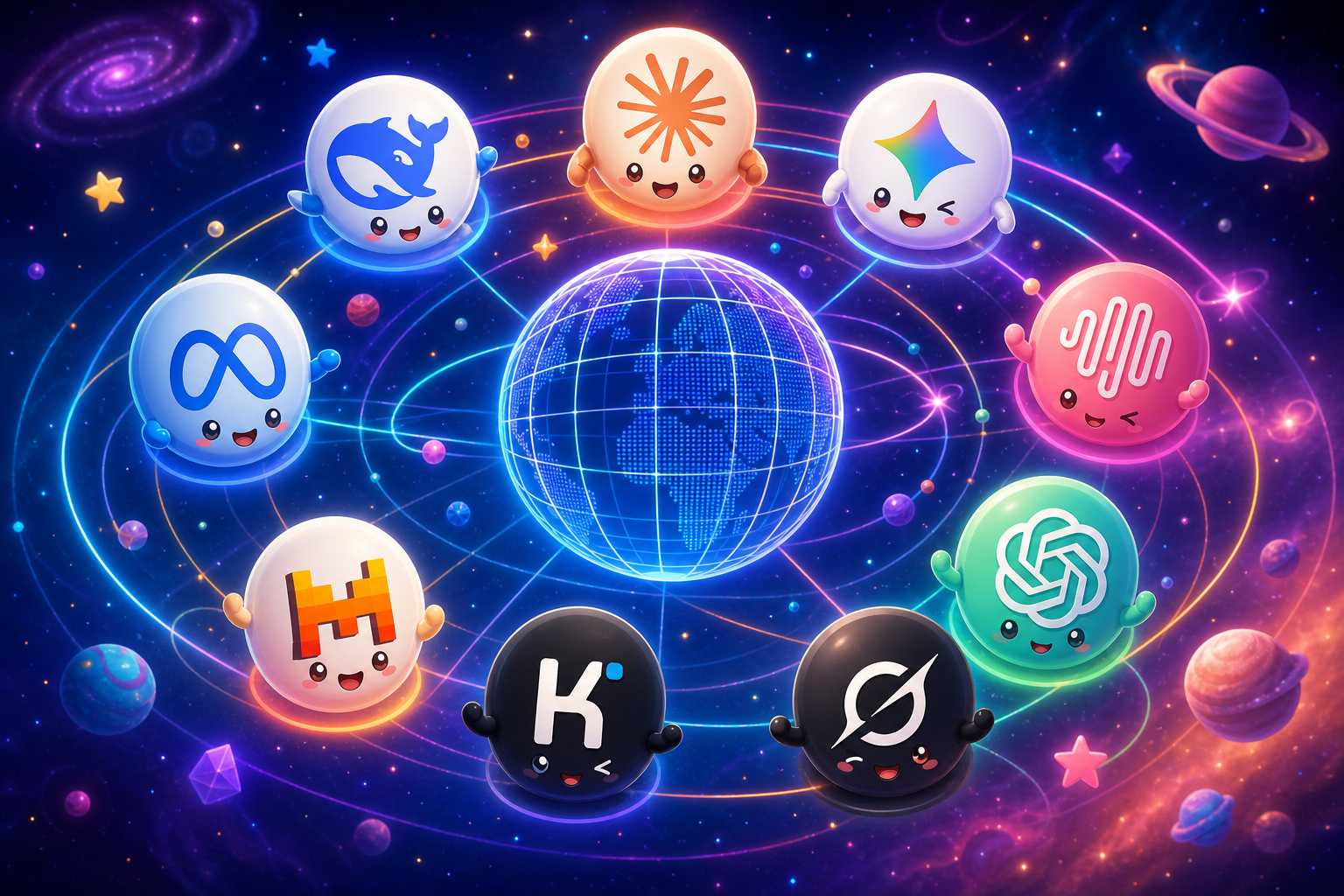
When you write in the Writing Studio, you choose which model writes. When you generate an image, you choose which model renders it. When you run a voice agent, you choose which model drives the conversation. 200+ models from OpenAI, Anthropic, Google, xAI, Meta, Mistral, Qwen, and DeepSeek are the engine - but the vehicle is a fully built platform designed to produce real outputs.
That's the distinction. A model router gives you access. Kunya gives you capability.
The Bottom Line
The best AI platform in 2026 isn't the one with the best single model. When billion dollar labs like OpenAI, Anthropic, Google and others compete to be number one, why pick and choose? Kunya gives you them all, with the orchestration layer, and workflows that actually work.
And you can try it right now