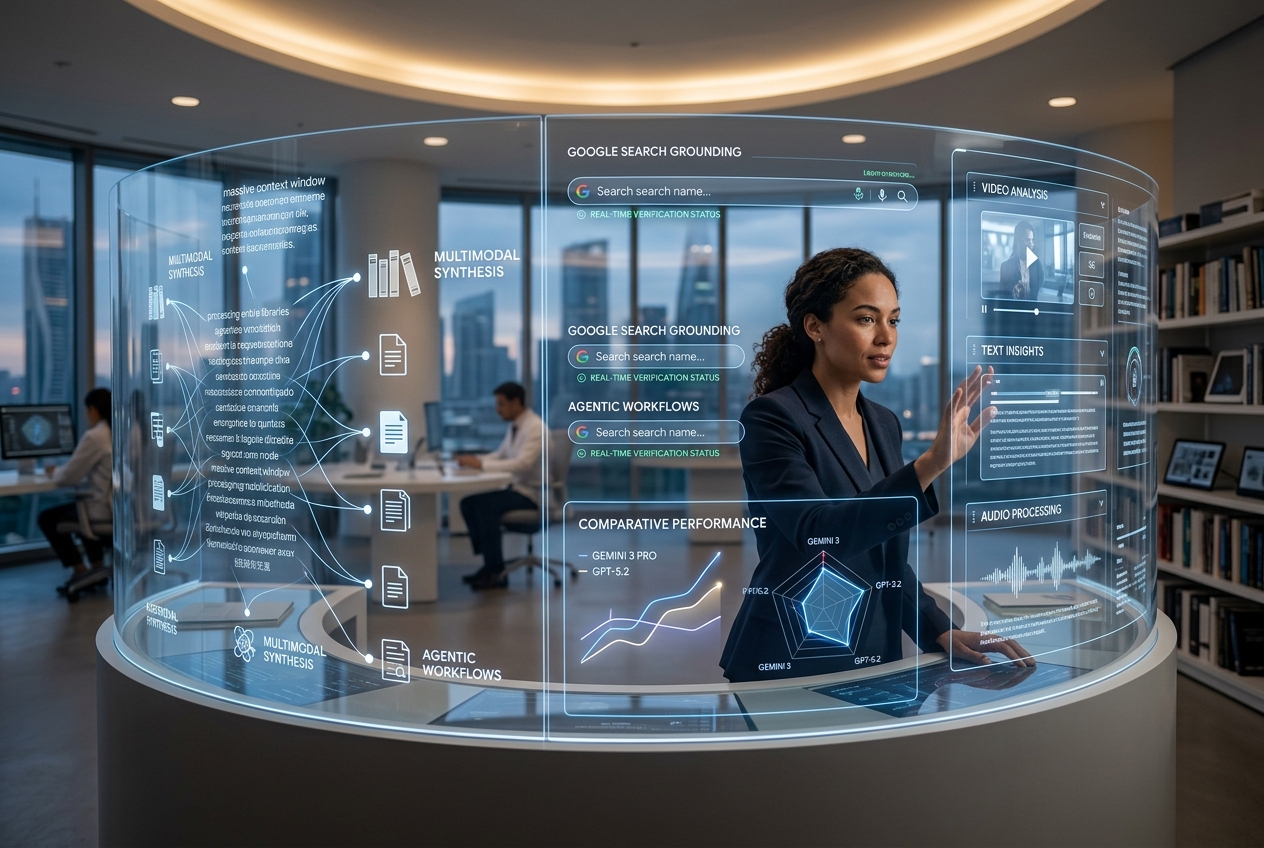
As of Monday, April 13, 2026, the landscape of artificial intelligence is no longer dominated by simple text predictors; it has evolved into a realm of deep, reasoning entities capable of operating across every sensory modality. The release of Gemini 3 Pro 2026 marks a definitive shift in this trajectory, establishing Google DeepMind as a leader in high-context, multimodal intelligence. This model is not merely an incremental update but a complete architectural reimagining that allows professionals to process vast amounts of data across text, video, audio, and code simultaneously. For the modern researcher or creator, understanding how to navigate these capabilities is essential for maintaining a competitive edge in an automated economy.
The current state of the industry suggests that intelligence is now measured by "thinking time" and "context depth." While the previous year focused on raw speed, the 2026 standard emphasizes the quality of multimodal AI tasks and the reliability of agentic execution. Gemini 3 Pro represents the pinnacle of this shift, offering a 1,000,000 token context window that functions as an external cognitive hard drive for the user. Whether you are analyzing a multi-hour corporate summit or refactoring a massive legacy codebase, this model provides the architectural foundation required for professional excellence.
The Architectural Evolution of Gemini 3 Pro 2026
To understand the current dominance of Google's flagship, one must look at the transition from the base Gemini 3 model released in late 2025 to the 3.1 Pro iteration that arrived on February 19, 2026. This ".1" increment was significant. It replaced the traditional mid-cycle ".5" update strategy with a focused leap in core reasoning and agentic stability. This version introduced the Three-Tier Thinking System, which allows users to choose between low, medium, and high compute modes depending on the complexity of the problem at hand.
The 3.1 Pro model is specifically tuned for tasks where a simple answer is insufficient. It leverages a new mixture of experts (MoE) architecture that has been optimized for the Gemini API, ensuring that agentic AI performance 2026 remains consistent even during high-load periods. For developers, this means that the model can now handle terminal-bench 2.0 tasks, such as file system navigation and dependency management, with a 68.5 percent success rate. This level of autonomy was previously unattainable for non-reasoning models.
The Massive 1M Token Context Window
One of the most transformative features of the 3.1 Pro model is its 1,048,576 token input capacity. In practical terms, this allows the model to ingest and reason over 8.4 hours of audio, over 900 individual images, or nearly 1,000 pages of text in a single prompt. For those involved in Google Gemini research, this eliminates the need for complex retrieval-augmented generation (RAG) pipelines for many common tasks. The model simply "remembers" the entire dataset within its active working memory.
Furthermore, the output capacity has been expanded to 65,536 tokens. This is a critical development for professionals who found earlier models frustrating due to truncated responses during long-form writing or complex coding tasks. With this expanded output, the model can generate entire chapters of technical documentation or complete software modules without losing its internal logical consistency.
Mastering Multimodal AI Tasks for Professional Research
In 2026, a "multimodal" model must do more than just "see" an image; it must understand temporal relationships and spatial logic. Gemini 3 Pro distinguishes itself by its native video understanding. Unlike legacy systems that process video as a series of disconnected frames, Gemini 3 Pro understands the narrative flow and the causal links within a video file. This makes it an indispensable tool for media analysts, legal professionals reviewing bodycam footage, and educators creating visual summaries.
Multimodal AI tasks now include the ability to generate, animate, and visually render SVG graphics and 3D code directly from natural language. This native SVG 3D code rendering capability is a cornerstone of the model's creative suite. It allows a user to describe a complex mechanical part and receive a fully interactive, three-dimensional visualization that can be imported into engineering software or a Three.js environment.
Unlocking Insights from Audio and Video
The processing of audio has reached a level of precision that matches professional transcription services. When using Gemini 3 Pro for multimodal AI tasks, the model can distinguish between subtle emotional cues in a speaker's voice while simultaneously transcribing the text and translating it into over 100 languages. This is particularly useful when paired with tools like OpenAI Whisper, which remains a gold standard for raw speech recognition, while Gemini handles the high-level semantic analysis.
- Temporal Analysis: Summarize discussion points from a three-hour board meeting with timestamped accuracy.
- Visual Extraction: Identify specific objects or text within a video stream and correlate them with spoken dialogue.
- Sentiment Mapping: Track the emotional trajectory of a customer service call to identify points of friction.
- Multilingual Synthesis: Ingest 10 different videos in 10 different languages and produce a unified English report.
Agentic AI Performance 2026: Benchmarks and Real-World Success
The primary metric for AI success in 2026 is no longer just "fluency" but "agency." Can the model act as a reliable partner in a multi-step workflow? The benchmarks for agentic AI performance 2026 show that Gemini 3.1 Pro has surpassed many of its competitors in long-horizon task coordination. Specifically, it scores 33.5 percent on the APEX-Agents benchmark and 69.2 percent on the MCP Atlas for tool coordination.
When comparing Gemini 3 Pro vs GPT 5.2 for multimodal reasoning, the data reveals a competitive struggle. While GPT 5.2 often excels in creative prose and nuanced dialogue, Gemini 3 Pro dominates in tasks requiring rigorous logic and massive document ingestion. On the ARC-AGI-2 benchmark, which evaluates a model's ability to solve entirely new logic patterns, Gemini 3.1 Pro achieved a verified score of 77.1 percent. This is more than double the reasoning performance of the base Gemini 3 Pro model from just a few months prior.
Benchmark Comparison Table: Frontier Models 2026
| Benchmark Category | Gemini 3.1 Pro | GPT 5.2 Pro | Claude Opus 4.6 |
|---|---|---|---|
| Abstract Reasoning (ARC-AGI-2) | 77.1% | 71.4% | 74.2% |
| Coding (LiveCodeBench Elo) | 2887 | 2845 | 2810 |
| Software Engineering (SWE-Bench) | 80.6% | 78.2% | 76.5% |
| Agentic Tool Coordination (MCP) | 69.2% | 65.1% | 68.4% |
| Context Window (Tokens) | 1,000,000 | 1,050,000 | 800,000 |
As the table demonstrates, agentic AI performance 2026 is extremely tight among the top three models. However, Gemini's superior coding performance and reasoning scores on ARC-AGI-2 make it a preferred choice for high-stakes technical environments. Professionals looking for deep logical consistency often find that Gemini 3 Pro behaves with a level of "academic rigor" that rivals human experts in specialized fields.
Advanced Google Gemini Research and Search Grounding
A recurring pain point in early AI models was the tendency to hallucinate facts. In 2026, Google Gemini research has addressed this through integrated Search Grounding. This feature allows the model to cross-reference its internal knowledge with the live web in real-time. When a user asks for the latest regulatory changes in the European Union, the model doesn't just guess based on its training data; it queries Google Search, verifies the sources, and provides a cited response.
This grounding is critical for how to use Gemini 3 Pro for complex research tasks. In academic and corporate settings, the ability to trust the model's output is as important as the model's speed. By leveraging the vast index of the web, Gemini 3 Pro acts as a high-speed research assistant that can synthesize disparate data points into a coherent, evidence-based argument. This has made it the leading model for NotebookLM, where it helps users organize their own private documents alongside the world's public information.
Reducing Hallucination with Reasoning Chains
Beyond external grounding, the 3.1 Pro model utilizes internal reasoning traces to verify its own logic. Before presenting an answer, the model goes through a hidden "Chain of Thought" process. It questions its own assumptions, checks for logical contradictions, and refines its output. This has led to a 33 percent reduction in factual errors compared to legacy models from 2025. For users of GPT-5.2 Pro, the experience will feel familiar, but with a unique focus on Google's search ecosystem integration.
Using Kunya to Leverage Gemini 3 Pro Context Windows
While Google provides its own platforms, Kunya Gemini workflows offer a more flexible approach for teams that need to integrate multiple models into a single workspace. By using Kunya to leverage Gemini 3 Pro context windows, users can combine Gemini's deep reasoning with other tools in the Kunya suite, such as the Three.js game studio or the AI voice call agents. This consolidation allows a creator to move from a complex research phase directly into a production phase without switching subscriptions.
Within the Kunya environment, Gemini 3 Pro functions as the "brain" of the operation. You can feed a massive PDF library into a Kunya workspace and use Gemini to extract key data points, which are then used to fuel your marketing studio or writing studio. The credit-based system at Kunya AI ensures that you are only paying for the high-compute reasoning when your task actually requires it. This is particularly beneficial for startups that need to maximize their AI spend across various specialized models like Claude Opus 4.6 or Llama 4.
How to Set Up a Kunya Gemini Workflow
- Document Ingestion: Upload your entire project directory or a library of research papers to a Kunya workspace.
- Model Selection: Select Gemini 3.1 Pro as your primary reasoning engine to handle the massive context.
- Prompt Engineering: Use advanced prompts to ask for a synthesis of the uploaded data, specifying the need for Search Grounding if current data is required.
- Multimodal Output: Direct the model to generate a structured report, an SVG visualization of the data, and a summary script for a video presentation.
- Execution: Pass these outputs to the Kunya Writing Studio or Video Generation tools to bring the project to life.
How to Use Gemini 3 Pro for Complex Research Tasks
To truly master how to use Gemini 3 Pro for complex research tasks, one must adopt a systematic approach to prompting. The model thrives on structure and context. Rather than asking a broad question, provide the model with a clear role, a specific dataset to analyze (via the context window), and a defined output format. In 2026, researchers are using these models to perform "meta-analyses" of thousands of papers simultaneously, a task that would take a human team months to complete.
For example, a medical researcher can upload five years of clinical trial data. The model can then be tasked with identifying specific patterns of side effects that only occur in a certain demographic, cross-referencing these findings with current pharmacological databases via Search Grounding. The result is a highly specific, actionable insight that is backed by data. This is the essence of professional excellence in the AI era.
Best Practices for Prompting Gemini 3 Pro
- Contextual Framing: Always start by defining the corpus of data you have provided. Example: "Based on the 500 clinical studies I have uploaded, analyze the following..."
- Configurable Reasoning: If your task is simple, use the "Low" compute mode to save time. For deep architectural reviews, specify "High" compute to ensure maximum logical depth.
- Multimodal Prompts: Don't be afraid to mix media. Example: "Explain the transition at 05:22 in this video by comparing it to the schematic diagram on page 42 of the PDF."
- Iterative Refinement: Use the model's 65K output tokens to ask for comprehensive drafts, then use follow-up prompts to drill down into specific sections.
Multimodal Agentic Workflows with Google AI in 2026
The future of work lies in multimodal agentic workflows with Google AI in 2026. An "agentic workflow" is one where the AI is given a goal rather than a set of instructions. For example, a marketing lead might give the agent the goal: "Analyze our competitor's video ads from the last quarter, identify their three most successful emotional hooks, and create a set of five SVG storyboards for our next campaign that counter those hooks."
The agent then uses its multimodal capabilities to watch the videos, its search grounding to check the engagement metrics of those videos on social media, and its reasoning engine to synthesize the strategy. Finally, it uses its generative capabilities to produce the storyboards. This entire loop happens with minimal human oversight, allowing the professional to focus on the high-level strategic decision of which campaign to launch. This is the promise of Gemini 3 Pro 2026: the compression of weeks of work into minutes.
The Impact on Software Engineering
In the realm of software development, the 3.1 Pro model is a revelation. With an 80.6 percent success rate on SWE-Bench Verified, it is now capable of resolving real-world software issues autonomously. This includes understanding the entire dependency graph of a project, navigating the file system, and writing the necessary patches. Developers are no longer just writing code; they are managing a fleet of AI agents that maintain the codebase, allowing the human engineer to focus on system architecture and user experience.
Conclusion: The Path to Professional Excellence with Gemini
Gemini 3 Pro 2026 has redefined what it means to be a "smart" model. By combining a massive context window with native multimodal understanding and rigorous search grounding, Google has created a tool that functions as a true extension of human intellect. Whether you are conducting Google Gemini research or building complex Kunya Gemini workflows, the key to success lies in understanding the model's strengths: its deep reasoning, its massive memory, and its ability to act as an autonomous agent.
As we navigate this new era, the distinction between human and AI output will continue to blur, but the value of human judgment remains paramount. Models like Gemini 3 Pro are human amplifiers; they take our most ambitious ideas and provide the data, the logic, and the generative power to bring them to life. By mastering these tools today, you are ensuring your place in the professional landscape of tomorrow. To experience the full power of these models alongside over 100 other frontier systems, register for a free trial at Kunya AI and start building your first agentic workflow today.
Key Takeaways:
Further Reading
- Gemini 3 Developer Guide | Gemini API | Google AI for Developers
- Gemini 3.1 Pro Complete Guide: Mastering Complex Tasks with the Three-Tier Thinking System | Gemini Lab
- Gemini-3-Pro: Mastering Multimodal AI Capabilities – Nipun Batra Blog
- Mastering Google Gemini AI: Unlocking Its Full Potential for Productivity & Creativity in 2026 | AI Tools Insights | AI Tools Insights
- Master Gemini 3 Pro: Complete Guide for Researchers, Developers & Students | Multimodal AI Tutorial
- Gemini 3.1 Pro: A smarter model for your most complex tasks
- Reasoning Leap: The 3.1 Pro update doubled the reasoning performance of previous models, scoring 77.1 percent on ARC-AGI-2.
- Contextual Mastery: A 1M token context window allows for the ingestion of entire libraries, hours of video, and massive codebases.
- Multimodal Depth: Native video understanding and 3D SVG rendering enable creative and analytical tasks that were previously impossible.
- Reliable Grounding: Google Search integration minimizes hallucinations, making Gemini 3 Pro a trusted partner for complex research.
- Agentic Prowess: The model is a leader in autonomous software engineering and multi-step tool coordination.