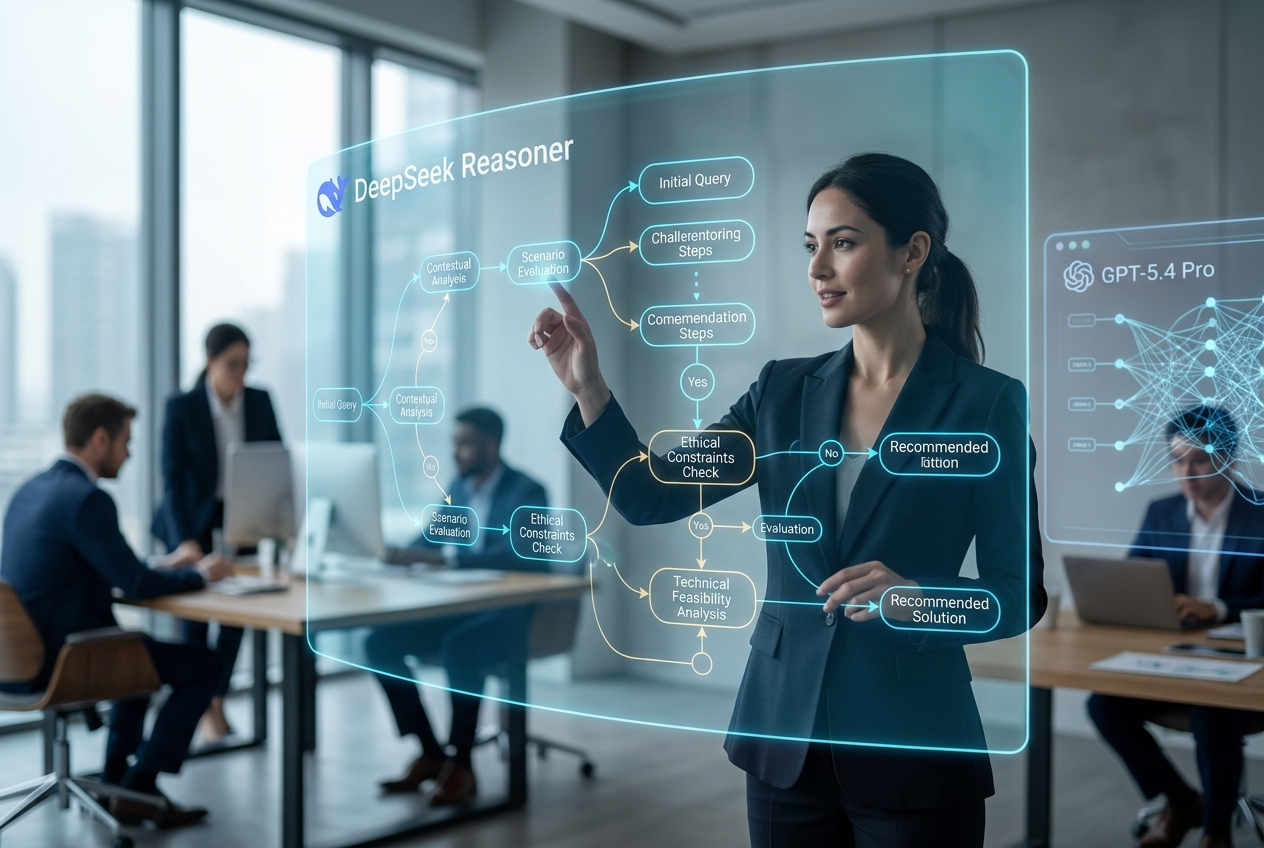
As of Monday, April 13, 2026, the global landscape of artificial intelligence has moved past the era of simple pattern matching into a sophisticated age of deep, deliberative logic. Today, the most pressing challenges facing developers and enterprise leaders are not about who can generate the most text, but who can solve the most complex problems with the highest degree of accuracy. DeepSeek Reasoner 2026 has emerged as a formidable pillar in this new economy of intelligence, challenging the established giants with a transparent and cost-effective approach to thinking. This model represents a fundamental shift in how we interact with machines, moving from a black box response system to a collaborative partnership where the steps to a solution are just as important as the solution itself.
What is DeepSeek Reasoner 2026?
The DeepSeek Reasoner, often identified in technical circles as DeepSeek R1 or its more recent R2 evolution, is a specialized large language model designed for tasks that require intense logical processing. Unlike traditional models that predict the next token in a linear fashion, the Reasoner uses a chain of thought (CoT) process to deliberate before presenting a final answer. This internal deliberation allows the model to catch its own mistakes, verify mathematical proofs, and navigate complex programming architectures that would typically cause standard models to hallucinate.
In the 2026 ecosystem, the model is defined by its emergent reasoning behavior. DeepSeek achieved this not through massive sets of human labels, but through large scale reinforcement learning (RL) using their Group Relative Policy Optimization (GRPO) algorithm. This allows the model to discover its own strategies for solving puzzles, much like a human expert might pace around a room while thinking through a difficult problem. When you use the Kunya DeepSeek integration, you gain access to this reasoning trace, providing a window into the model's logic that was once hidden from view.
AI Reasoning Models Comparison: The Big Three of 2026
To understand the value of DeepSeek, we must look at the current market leaders. The 2026 competitive landscape is dominated by three main philosophies: the maximum compute approach of OpenAI, the multimodal agentic approach of Google, and the open weight efficiency of DeepSeek. When conducting an AI reasoning models comparison, the metrics have shifted from simple word counts to "reasoning tokens" and "cost per logical inference."
DeepSeek vs OpenAI 2026: The Economic Divergence
The primary battleground in the DeepSeek vs OpenAI 2026 rivalry is cost and transparency. OpenAI’s latest flagship, discussed in our guide on GPT-5.4 Pro: Maximum Compute for Complex Reasoning Challenges, is a powerhouse of intelligence, but it comes with a premium price tag and a proprietary "thinking" phase that is largely obscured from the user. DeepSeek has taken the opposite path by exposing the thinking process and driving the price of high level reasoning down by nearly 96 percent compared to its Western counterparts.
This economic divergence has led to a bifurcated market. Enterprises that require absolute performance regardless of cost often lean toward the OpenAI o-series. However, developers and startups who need to run thousands of complex logical checks per hour are flocking to the DeepSeek Reasoner. It has become the "workhorse of logic" for the mid-market, offering performance that rivals proprietary systems at a fraction of the overhead.
DeepSeek Reasoner Performance vs GPT 5.4 Pro
When evaluating DeepSeek Reasoner performance vs GPT 5.4 Pro, the data from April 2026 suggests a surprisingly narrow gap in specific domains. While GPT 5.4 Pro maintains a slight lead in creative nuance and broad world knowledge, DeepSeek holds its own, and occasionally surpasses, in mathematics and competitive coding. Recent updates to the DeepSeek R1-0528 variant have specifically targeted these technical benchmarks.
- Mathematical Accuracy: On the MATH-500 benchmark, DeepSeek Reasoner 2026 has pushed its performance from a 74.8 percent success rate to an impressive 82.8 percent.
- Coding Efficiency: In the LiveCodeBench tests conducted between January and March 2026, the model saw a jump in accuracy from 29.2 percent to 34.38 percent, particularly in solving novel algorithmic problems.
- Reasoning Depth: The model now supports an internal reasoning trace that can extend for several thousand tokens, allowing it to "think" through much longer horizons of logic than the previous year's versions.
Comparative Performance Table 2026
| Metric | DeepSeek Reasoner (R2) | GPT-5.4 Pro | Claude 4.6 Sonnet |
|---|---|---|---|
| API Price (per 1M tokens) | $0.60 (est.) | $30.00 | $3.00 |
| Thinking Trace Access | Full Transparency | Hidden/Obscured | Partial (via prompt) |
| MATH-500 Score | 82.8% | 85.1% | 80.4% |
| Primary Strength | Math & Engineering | General Reasoning | Coding & Nuance |
Logical AI for Human Flourishing
One of the most profound developments in 2026 is the use of logical AI for human flourishing. We are moving away from the idea that AI should be a replacement for human intelligence. Instead, models like DeepSeek Reasoner are being used to amplify human judgment. By showing its work, the model allows a human user to verify the logic, identify potential biases, and understand the "why" behind a recommendation. This is essential for maintaining human agency in an automated world.
Human flourishing in the AI era requires tools that act as cognitive mirrors. When a professional uses the DeepSeek Reasoner, they aren't just getting an answer: they are seeing a structured breakdown of a problem. This helps the user learn and refine their own thinking patterns. It turns the AI interaction into a pedagogical moment, where the human becomes smarter alongside the machine. This is a core reason why reasoning AI should augment human critical thinking rather than act as a total substitute.
Using DeepSeek Reasoner for Complex Ethical Decision Making
In 2026, we are seeing a massive uptick in using DeepSeek Reasoner for complex ethical decision making within corporate boardrooms and legal frameworks. Ethical problems are rarely binary. They involve a heavy weighting of competing values, long term consequences, and societal impact. A standard model might give a politically correct but shallow answer. A reasoning model, however, can map out the ethical landscape.
For example, a supply chain manager might use the DeepSeek Reasoner to weigh the cost benefits of a new supplier against environmental standards and local labor laws. The model can articulate the trade-offs in its reasoning trace: "If we prioritize the environmental metric by 20 percent, the projected cost increases by X, but the long term regulatory risk decreases by Y." This level of granular logic provides a transparent audit trail for human decision makers, ensuring that ethical choices are made with open eyes and documented rationale.
The "Thinking Mode" and Ethical Guardrails
An interesting technical quirk noted in early 2026 user reports involves the model's adherence to logic over social niceties. Some users have found that if a character description or an ethical prompt is framed with specific logical constraints, the Reasoner will follow those constraints to their literal conclusion. To manage this, researchers recommend providing a specific paragraph of "narrative instructions" that guide the model's tone without breaking its logical chain. This ensures that the model remains a useful partner in sensitive discussions without becoming a rigid, unfeeling calculator.
Cost-Effective Reasoning Models for Developers in 2026
For the technical community, the rise of cost-effective reasoning models for developers in 2026 has been a catalyst for a new wave of autonomous applications. In the past, running a "thinking" model was too expensive for most startups to integrate into their production loops. Today, with the DeepSeek API pricing trends, that barrier has effectively vanished. This democratization of logic means that even solo developers can build apps that perform multi-step research, automated debugging, and architectural audits.
Developers are using the Reasoner to power "agentic" workflows. In these systems, the AI doesn't just write a snippet of code: it writes the code, thinks through potential edge cases, generates a test suite, runs the tests in a sandboxed environment, and iterates until the code passes. Because the cost per token is so low, these recursive loops are finally financially viable. Systems like Kunya AI facilitate this by allowing developers to switch between DeepSeek and other models seamlessly, optimizing for cost during the drafting phase and switching to maximum compute models for final verification.
Distillation: Bringing Logic to the Edge
Another major trend for 2026 is the distillation of DeepSeek’s reasoning capabilities into smaller models. DeepSeek has successfully distilled the reasoning patterns from its massive 671B parameter R1 model into smaller, nimble models based on architectures like Qwen and Llama. These smaller models, ranging from 7B to 32B parameters, can run on local hardware while retaining a significant portion of the "thinking" ability of their larger counterparts. This is a game changer for privacy-focused enterprises that want high level logic without sending their data to the cloud.
Why Reasoning AI Should Augment Human Critical Thinking
The philosophical core of the DeepSeek project, and indeed the broader 2026 AI movement, is the belief that why reasoning AI should augment human critical thinking is rooted in the "Verification Gap." As AI becomes more capable, humans are increasingly unable to tell if a result is truly correct or just a very convincing hallucination. Reasoning models solve this by showing their work. They provide the "proof" that a human can then check.
If we treat AI as an oracle, our own critical thinking skills will atrophy. If we treat it as a collaborator that must justify its steps, our skills are sharpened. We become editors and auditors rather than just passive consumers of information. The DeepSeek Reasoner encourages this auditor mindset by default. Its very structure invites the user to look at the reasoning trace and say, "I see where you made that assumption, but what if we change this variable?" This keeps the human in the loop in a meaningful, intellectually rigorous way.
Kunya DeepSeek Integration: Seamless Access to Frontier Logic
The Kunya DeepSeek integration provides a unique bridge for users who want the power of DeepSeek without the complexity of managing individual API keys and rate limits. On the Kunya platform, the DeepSeek Reasoner exists alongside over 100 other models, including the latest from OpenAI, Anthropic, and Google. This allows for a "best of both worlds" workflow that is becoming the standard for 2026 professionals.
For instance, a user might use DeepSeek Reasoner 2026 to structure a complex legal argument, taking advantage of its deep logical chains and low cost. Once the logic is solidified, they can use Claude Sonnet 4.6 to polish the prose and ensure the tone is appropriate for a high level court filing. This multi-model approach, coordinated within a single workspace, is where the true power of modern AI lies. To explore these workflows, developers can consult the Claude Sonnet 4.6: Wydajny fundament dla nowoczesnych programistów guide to see how different models complement the Reasoner's strengths.
How to Optimize Your DeepSeek Workflow on Kunya
To get the most out of the Reasoner on Kunya, users should follow a structured approach to prompting. Because the model is designed to think, it responds best to prompts that encourage step-by-step processing. Instead of asking for a final result, ask the model to "first analyze the constraints, then explore three possible solutions, and finally recommend the best one." This triggers the model's reinforcement-learned reasoning pathways and typically results in a much higher quality output.
- Use Workspace Context: Leverage Kunya's workspaces to provide the model with a large body of semantic context before asking a reasoning-heavy question.
- Monitor Reasoning Spend: Use the credit-based tracking on Kunya to see exactly how many reasoning tokens each query consumes, allowing for precise budget management.
- Multi-Model Verification: Use DeepSeek to solve a math problem and then use a model like GPT-5.1 to verify the steps, creating a "redundant logic" system for high-stakes tasks.
The Future of Logic: R2 and Beyond
Looking ahead into the remainder of 2026 and into 2027, the roadmap for DeepSeek includes even tighter integration between reasoning and multimodal capabilities. We are already seeing the first glimpses of DeepSeek-V3.2-Speciale, a model designed for "extreme thinking" tasks that might take several minutes to complete. This moves us toward a future where AI isn't just a chat box, but a research partner that goes away, thinks for a significant amount of time, and returns with a comprehensive report.
The "Reasoning Economy" is only just beginning. As the cost of a "logic gate" continues to drop, we will see these capabilities embedded in everything from autonomous vehicles to real-time financial trading systems. The key will be maintaining the transparency that models like DeepSeek have championed. If we lose the ability to see the reasoning trace, we lose the ability to trust the system. Fortunately, the 2026 trend toward "open logic" suggests that the future of AI will be a visible, verifiable one.
Conclusion: Mastering the New Logic with DeepSeek and Kunya
The DeepSeek Reasoner 2026 has fundamentally changed the rules of the AI game. By prioritizing transparent chain-of-thought processing and radical cost efficiency, it has challenged the narrative that frontier intelligence must be an expensive, closed secret. For humans, this means a future where AI is not a replacement for critical thinking, but a powerful catalyst for it. Whether you are using it for complex ethical decision making or high-stakes engineering, the Reasoner provides the logical backbone needed for human flourishing in a digital world.
The journey toward mastering these tools starts with curiosity and the right platform. By leveraging the Kunya DeepSeek integration, you can experiment with these frontier reasoning models alongside the world’s most advanced creative and agentic systems. This flexibility ensures that you are always using the right tool for the job, balancing the depth of a reasoning trace with the nuance of human-centric prose. As we move further into 2026, those who can orchestrate these diverse intelligences will be the ones who lead the next wave of innovation.
Ready to experience the future of logic? Sign up for Kunya AI today and gain access to the DeepSeek Reasoner along with over 100 other cutting-edge models in one unified workspace. Start your free trial with no credit card required and see how deep thinking can transform your workflow.
Key Takeaways for April 2026
- Reasoning over Pattern Matching: The shift from GPT-4 era chat to DeepSeek-style reasoning marks the birth of AI as a true logical partner.
- Transparency is Trust: The ability to view a reasoning trace is essential for verifying complex outputs and learning from the AI's logic.
- Economic Democratization: DeepSeek’s pricing has made high-level logic affordable for everyone, driving the growth of agentic workflows.
- Human-AI Collaboration: The goal of these models is to augment human judgment, providing a "second brain" for ethical and technical auditing.
- Unified Workflows: Using platforms like Kunya allows you to combine the logical depth of DeepSeek with the creative power of other frontier models for a complete solution.
As the year progresses, stay informed on the latest developments in reasoning models by following our deep dives into systems like GPT-5.1: Mastering Configurable Reasoning Effort for Precision and the evolving landscape of Gemini 3.1 Pro: Google’s Most Advanced Reasoning Model in 2026. The future of logic is here, and it is more accessible than ever before.
Further Reading
- A Technical Tour of the DeepSeek Models from V3 to V3.2
- DeepSeek Reasoner - Chain of Thought AI for Math, Code & Agents
- DeepSeek v4: The Complete Guide to the AI That's Redefining Code and Reasoning
- DeepSeek AI
- DeepSeek-V3.2 Release | DeepSeek API Docs
- Reasoning Model (deepseek-reasoner) | DeepSeek API Docs